
I Ran the First Ever Family Law Ad on ChatGPT. Here’s How I Got It Approved.
I ran the first family law ad I can find anywhere inside ChatGPT. As of this writing, it’s been serving for just over a week now.
Here’s how I got it approved, and why it’s a bigger deal than one simple educational ad has any right to be.
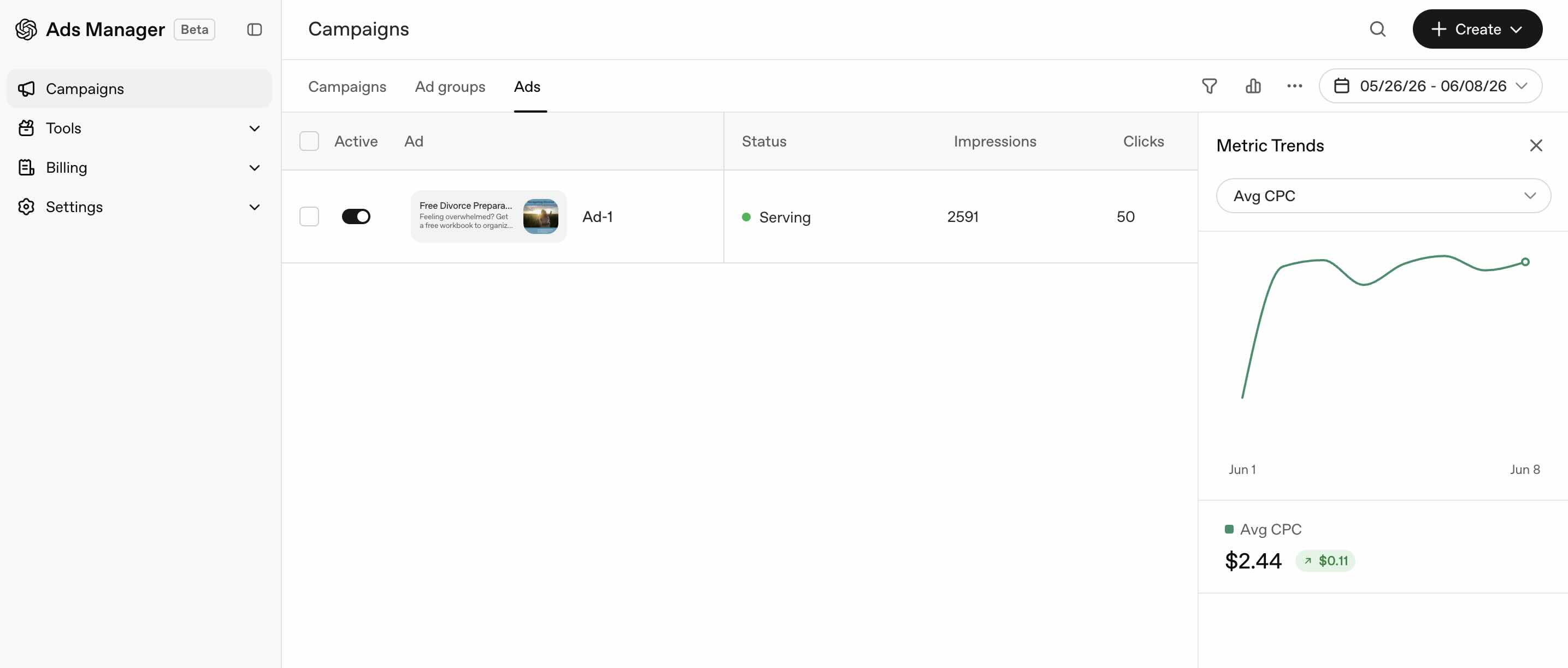
Let’s start with what just became possible. On May 5, 2026, OpenAI opened a self-serve ad platform inside ChatGPT to U.S. advertisers — cheap clicks, an audience north of 900 million people a week, a brand-new channel almost no one in the legal field could touch. The kind of opening that doesn’t stay open long.
There was one problem for law firms. OpenAI’s ad policy flatly disallows advertising for legal advice, representation, or legal services. It names personal injury, immigration, legal claims, and document preparation directly. So the obvious move — advertise your firm, offer a consultation — is off the table.
Most people who looked at this stopped there and concluded law firms simply can’t advertise on ChatGPT.
I didn’t read it that way. Buried in the same policy is one narrow exception: ads for general legal education or media are allowed where no legal services are offered, with examples like legal podcasts and educational materials. A couple weeks before I ran a single ad, I noticed that exception and wrote about what it could mean — that a law firm could reach clients through genuine education, at the exact moment they’re researching, even though it can’t advertise services.
I called it the ChatGPT Ads loophole for law firms, you can read the full framework I wrote here: https://www.linkedin.com/pulse/chatgpt-ads-law-firms-loophole-how-attorneys-can-advertise-little-vrvwe/
That was a theory. What I’m describing now is the proof. I built the educational resource, pointed an ad at it, got rejected, worked out why, fixed it, and got it approved.
The carve-out I argued would work, works.
And as far as I can find, no one had done it in family law. The legal “firsts” people have claimed since the May launch were all personal injury. So this is the first confirmed family law ad to run on the platform. The rest of this is exactly how it happened, including the parts I won’t oversell.
Let me back up to why I was trying in the first place, because it wasn’t to win a marketing race.
I keep thinking about where divorce clients really are now.
Last night, there was a woman awake at 1 AM, asking ChatGPT the questions about her marriage she hasn’t said out loud to anyone — what happens to the house, whether she can file without him knowing, how to bring it up without it turning into a war.
People are working through the most frightening season of their lives inside a chat window, months before they ever call a lawyer. If a firm can show up there with something that helps, that’s worth figuring out.
I care about that more than is strictly professional, and I’ll say why plainly. I’m a child of divorce. My parents’ was the kind with a lot of conflict, the kind that was going to happen no matter what anyone did. You don’t forget what that does to you or to your family.
It’s the reason I do this work at all: I want to help people going through it avoid as much of that pain as their situation will allow. So when the question became whether a family law firm could reach people at the exact moment they’re trying to make sense of it, it wasn’t an abstract puzzle to me.
Now, here is how I got it approved.
My first attempts were rejected, which threw me, because the thing I was promoting was a free divorce-preparation workbook. It technically complied with the stated policy. No fee, no pitch, just help. It fit the educational carve-out in their policy I’d written about. So why the rejection?
The destination. I’d pointed the ad at a place that plainly belonged to a business that sells legal services, and the review looks at where you’re sending people, not just the cover of your guide or your ad copy. Educational content aimed at an obvious law-firm storefront still reads as advertising legal services. That one distinction is the whole game, and once I understood it, the fix was more straightforward but I still didn’t know if it would work.
I moved the resource onto a sub-domain of the client’s primary website; the domain itself has a topical name rather than one branded to a firm, and I took everything off the front end of the sub-domain that looked like selling. No firm name, no attorney named, no consultation offer, no “book a call,” nothing tied to a specific jurisdiction. Just a clean educational site and one thing to do: get the workbook. I built it out enough that it reads like the educational resource it is, not a one-page funnel with a download bolted on. I resubmitted, and it cleared.
I want to be careful about how much credit I take for cracking some code, because I have one approval that they could stop serving any time and not a controlled experiment. The topical destination probably helped, since it doesn’t announce “law firm” the way a firm-branded address would. The purely educational framing almost certainly helped. The clean separation between the free resource and anything resembling a sales offer helped. What I won’t do is hand you a guaranteed formula for what a human reviewer will approve, because I don’t have one, and neither does anyone claiming otherwise this early.
There’s one part of this I’d want a fellow professional to take away, because it’s the part the people running victory laps this season keep skipping.
Getting OpenAI to approve the ad was the easy gate. The hard gate is that lawyer advertising is regulated state by state, and the rules differ in real ways. The model everyone gravitates toward — a clean educational front that captures interest, with the firm reaching those people afterward — sits right on top of the questions bar regulators care about most: whether someone could reasonably be misled about who’s behind the resource, and whether the later contact could look like solicitation. There are a lot of variables, and those questions don’t come out the same way in every jurisdiction.
In some states, a disclosed and carefully built version of that approach may hold up fine. In the state where I ran this, my own read was that the more aggressive version or one run from a totally unrelated non-firm owned educational domain came too close to the line for me to be comfortable putting a client there, so I built it conservatively instead of pushing it. That was a judgment call, and I think thoughtful lawyers could land somewhere different.
Which is exactly why I won’t pretend there’s a single national playbook. There absolutely isn’t, and any agencies acting like there is are the ones whose clients are most likely to end up explaining themselves to a grievance committee.
The way I’d put it to a managing partner: treat the OpenAI approval and your state’s advertising rules as two separate problems, assume your bar’s rules apply in full, and have your own ethics counsel look at both the creative and the funnel before anything goes live. None of that is a reason to sit out. It’s the difference between marketing that helps your firm and marketing that becomes its own headache.
So here’s what I have. A real, approved family law ad serving in the place a huge number of your future clients are already spending their late nights. Proof that the carve-out I theorized about weeks ago holds up in practice. And a much clearer picture of where the real risk lives, which is downstream of OpenAI, in fifty different rulebooks.
What I don’t have yet is proof this produces cases. It’s early, the numbers so far are small, and I’d be doing you a disservice to suggest otherwise. The value right now is in understanding the channel before your competitors do, and in building the kind of educational presence that pays off across everything AI is changing about how people find lawyers — whether or not the ad itself ever becomes a major source of clients.
If you want to think through whether any of this fits your firm — or, more usefully, what the larger shift in how clients find lawyers means for your marketing — that’s the work I do as a fractional CMO. I’ll give you a straight read at no charge.
Book a strategic assessment: https://calendly.com/joshuadlittle/aquila-assessment — or just email me at joshua@aquila.law.
